Lugu Lake (Yunnan – Sichuan)
Early in the morning, we take a shared taxi from Lijiang to Lugu Lake, which lies on the border of Yunnan and Sichuan. Unfortunately non of the five Chinese women, nor the young teenage girl, is willing to offer Dave a better seat! So he ends up sitting with me in the back row, where he can hardly fit.
I am surprised by this seemingly “rude” attitude towards an elderly person, as older people are usually highly respected in China.
Not knowing yet, that four days later, we will both have a comfortable armchair seat in a van… but a crazy speedy driver instead! The Buddhist monk in the front seat balances out the whole situation. Today I am not going to die!
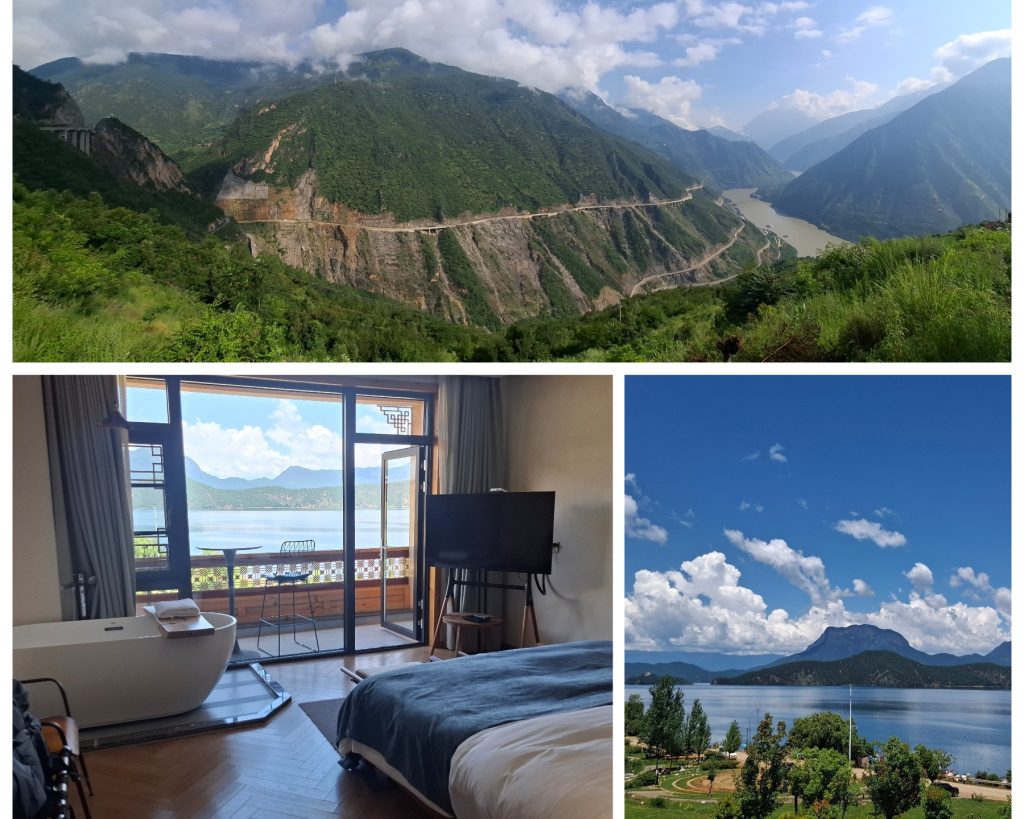
After a long four-hour drive, with one scenic stop at the Shajin River Viewing Platform on the famous Eighteen Bends, we finally arrive at Lugu Lake. I pay the entrance fee to the Lugu Lake Scenic Area, while Dave gets in for free again because he is over 70. Our driver kindly drops us kindly off right in front of our hotel.
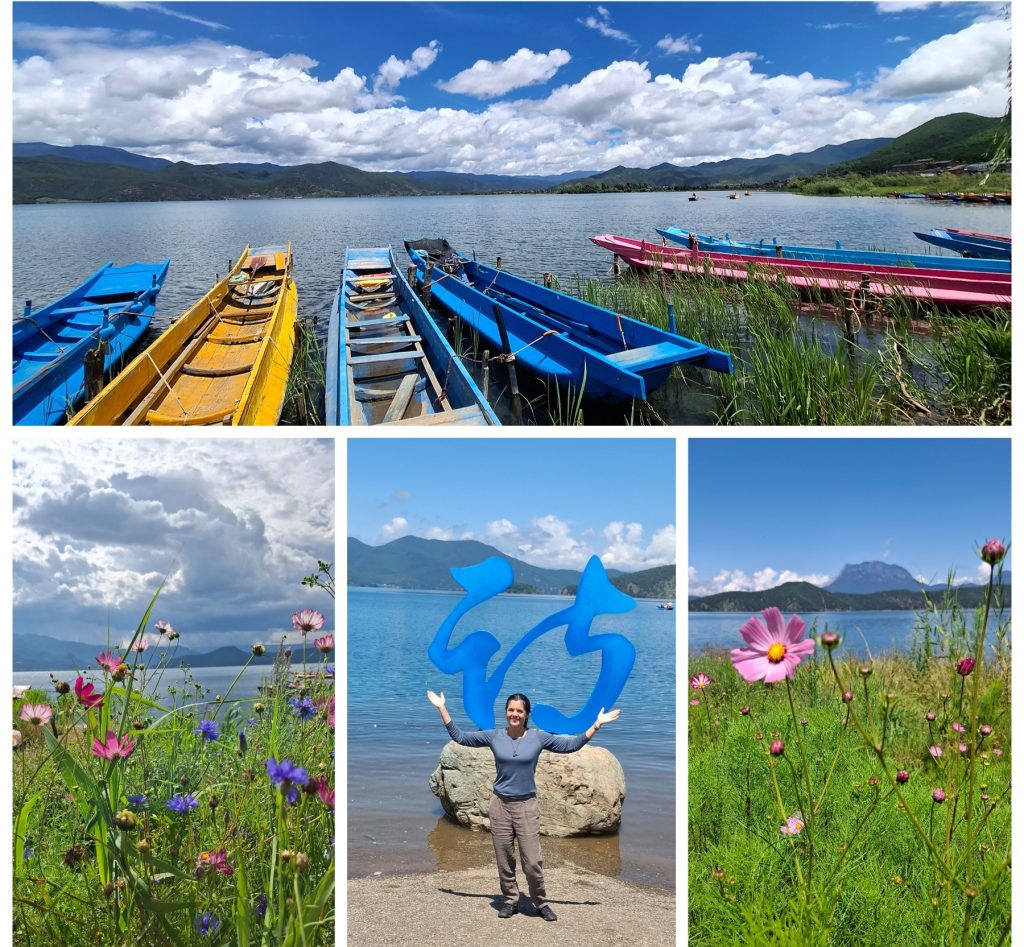
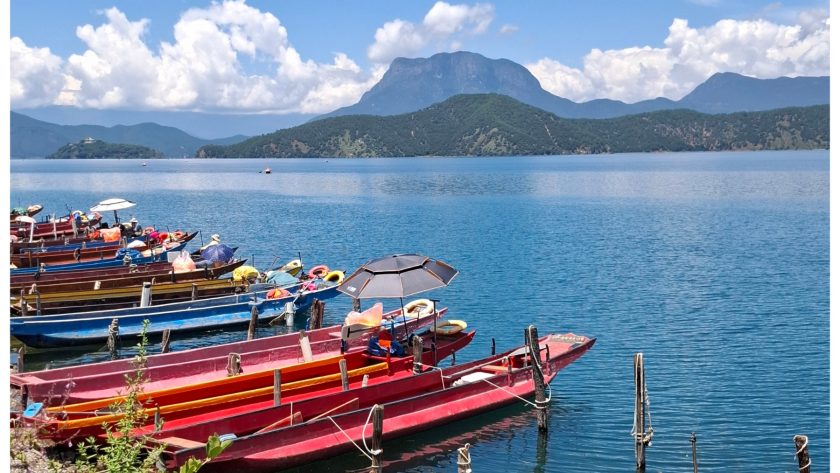
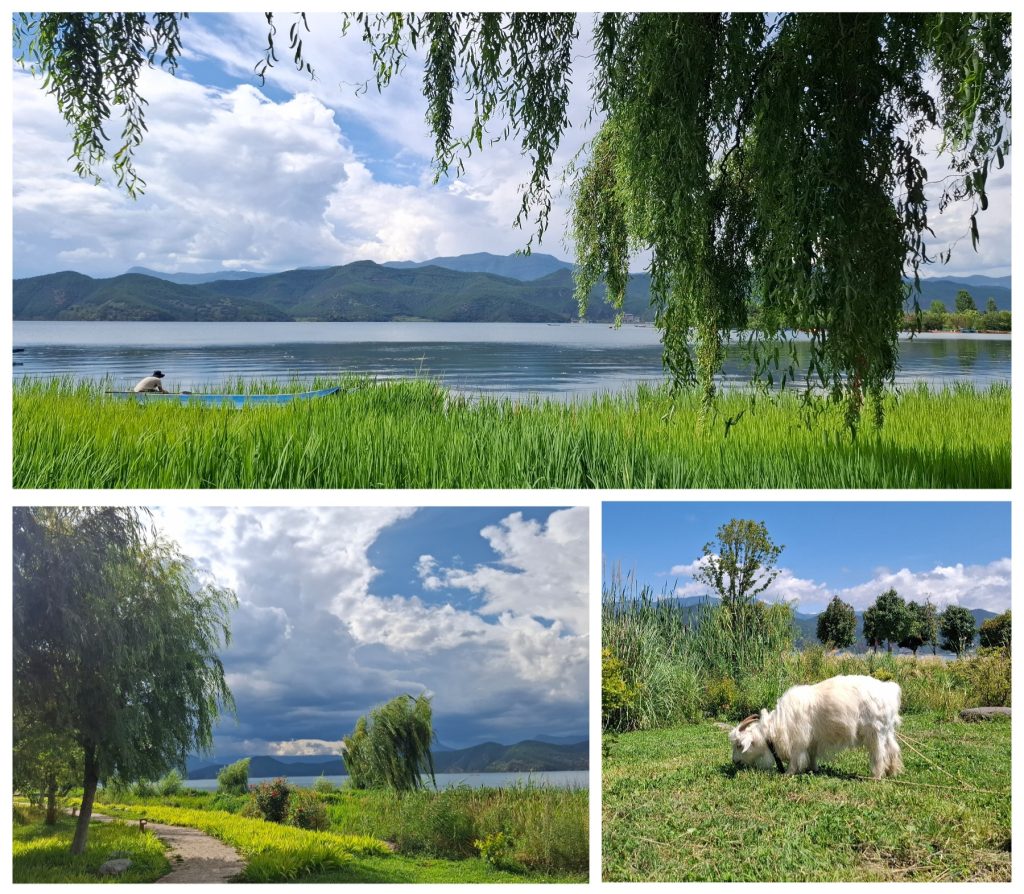
Our hotel is located directly across from Lvjiawan Wharf, where colourful pig-trough boats line up, ready to take passengers to Dahaibao island with its temple, or simply for a tour around the lake. The view from our balcony over this spectacular high-altitude freshwater lake, roughly 2.690 m above sea level and covering around 50 square kilometres, is breathtaking.
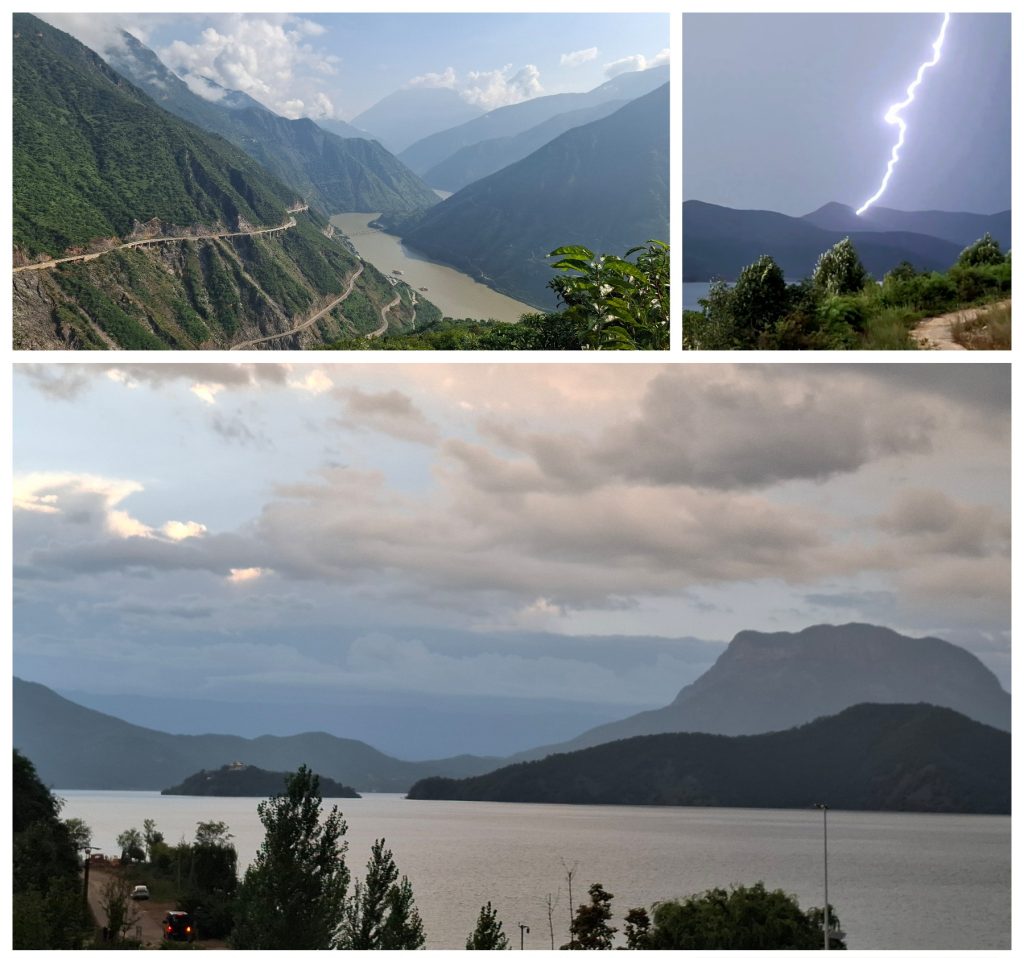
Due to the altitude, the temperature is cooler than elsewhere. The mornings are often cloudy, then the sun comes out, and most days end with heavy rain showers and the occasional thunder and lightning! I love it here!
Sightseeing
There is so much to explore around Lugu Lake, but it is hard to beat the view we have from our balcony. It’s impressive enough simply to stare at a lake sitting at 2.690 m above sea level.
The giant Gemu Goddess Mountain greets us every morning, fighting to reveal its peak through the thick clouds. Rising to approximately 3.754 metres, the mountain is sacred to the Mosuo people and is also known as Lion Mountain.
Scooter ride
One day, we decide to hire a scooter. After struggling for a while, we discovert that we can’t hire one of the white scooers because we don’t have a Chinese phone number. Eventually, we manage to hire a green one.
Of course, it all has to be done through an App by scanning a QR code. Sometimes the information is available in English; at other times, it is Chinese only! Anyway, once we get the scooter working, Dave goes for a short test ride.
He doesn’t seem comfortable on it at all. The scooter is small, the brakes are tricky… all in all not ideal. Still we set off for a little ride.
We pass Lvji Wanhupan View Point and visit Langfang Wharf and Puluo Wharf, but eventually decide to return the scooter to where we got it from. We don’t feel particularly safe on it. It was worth giving it a try, though!
The Musuo people
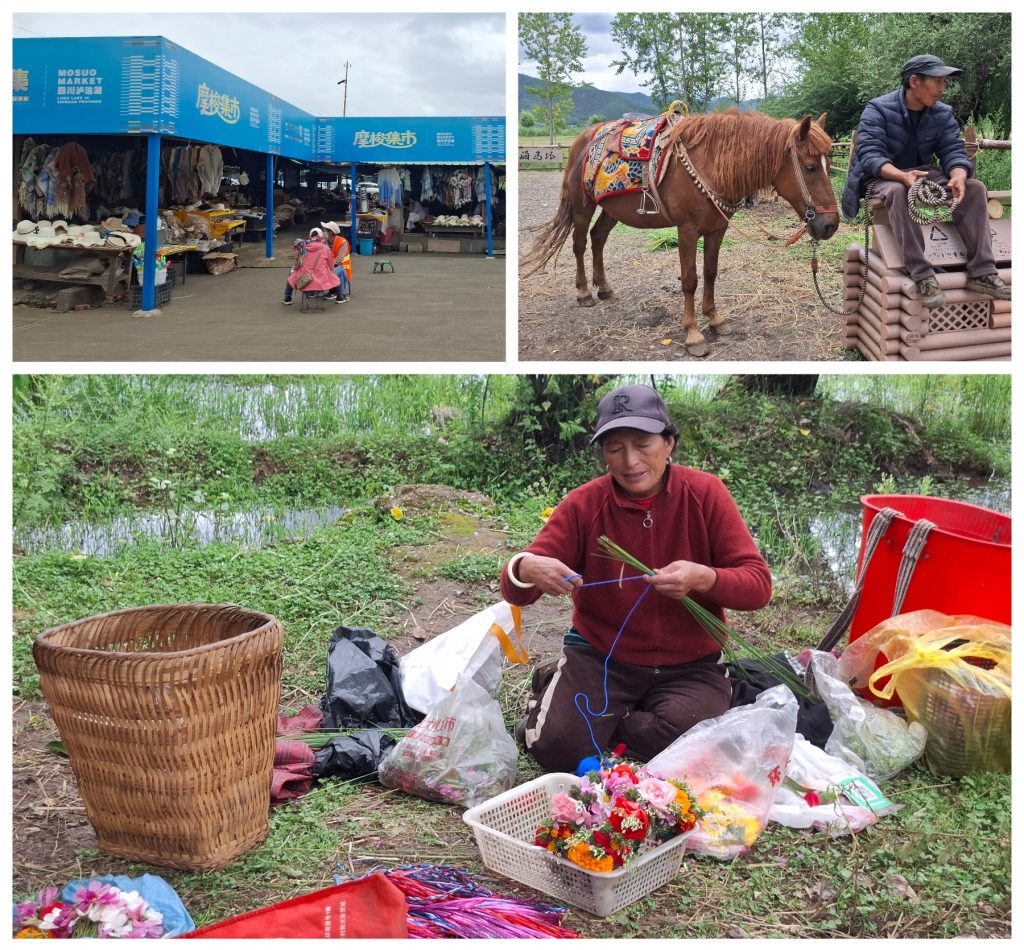
Lugu lake is the traditional homeland of the Mosuo, whose culture is probably the most fascinating aspect of the area, if you ask me. They are particularly known for their matrilineal family structure.
As our scooter experience doesn’t work out quite the way we had hoped, we decide to hire a driver and explore the lake by car instead, while learning more about the fascinating Mosuo. Apparently they are not officially recognised as a separate ethnic minority by the Chinese government and are generally classified within other officially recognised groups, particularly Naxi. China is rich of 56 official ethnic groups!
Our first stop is the daily Mosuo market, right next to the famous “Walking Marriage” Bridge. According to the information pannel, traditionally, some Mosuo woman and man form long-term relationships without establishing a conventional marriage household. In what commonly called “walking marriage”, a man may visit the woman’s home at night and return to his own maternal household during the day.
Mosuo Museum
I’m intrigued by the Mosuo traditions, and I wish my dad was here today! As a history teacher, he has always been able to provide me with more information. Although… I wonder whether he is familiar with the Chinese ethnic groups and the Mosuo. I miss him today, either way!
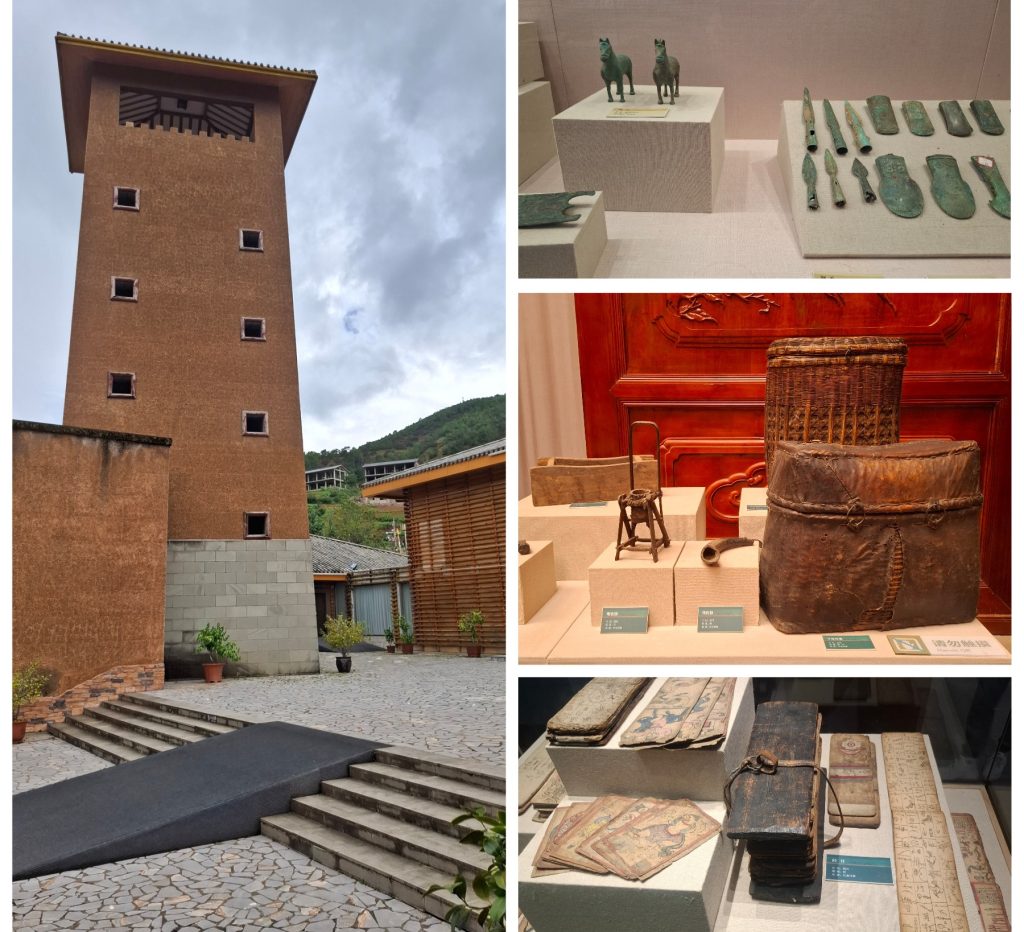
Our driver, who is Han Chinese, recommends a visit to what is described as the only Mosuo Museum in China. We pay the 20 CNY admission fee and start wandering around.
We see a typical room belonging to an adult Mosuo woman, where she can receive her partner in the evening. Both partners continue to live and work with their respective families during the day.
This form of traditional Mosuo marriage is called zuozuoga, which means “to exchange a pledge“. A man and a woman in walking marriage are called a “xiao“. Love is usually the basis for a walking marriage.
Children born from these “marriages” traditionally remain within the mother’s household and take her family name. The father fulfills whatever responsibilities he can, but the mother’s brother traditionally play an important role in raising and educating them.
Our driver explains, that the traditional Mosuo life is changing nowadays. They can marry someone from another ethnic group, and not everyone chooses to follow the traditional “walking marriage” system anymore.
Pig-trough boats
Another sections ofthe museum shows us more about the characteristic narrow wooden boats we have already admired on the lake. They are often called “pig-trough boats” because of their shape.
Traditionally made from a single piece of wood, these boats are still used today to transport tourists and visitors around the lake and to the islands. How colourful they are!
At the Mosuo market, we spot some pig-trough boats stuck among the reeds of Caohai, literally “Grass Sea“. This large shallow wetland area, filled with reeds ad aquatic vegetation, offers us a complete different view of the lake.
We continue our round trip, now passing along the eastern and northeastern side of the lake. We are officially in Sichuan, part of Yanyuan County!
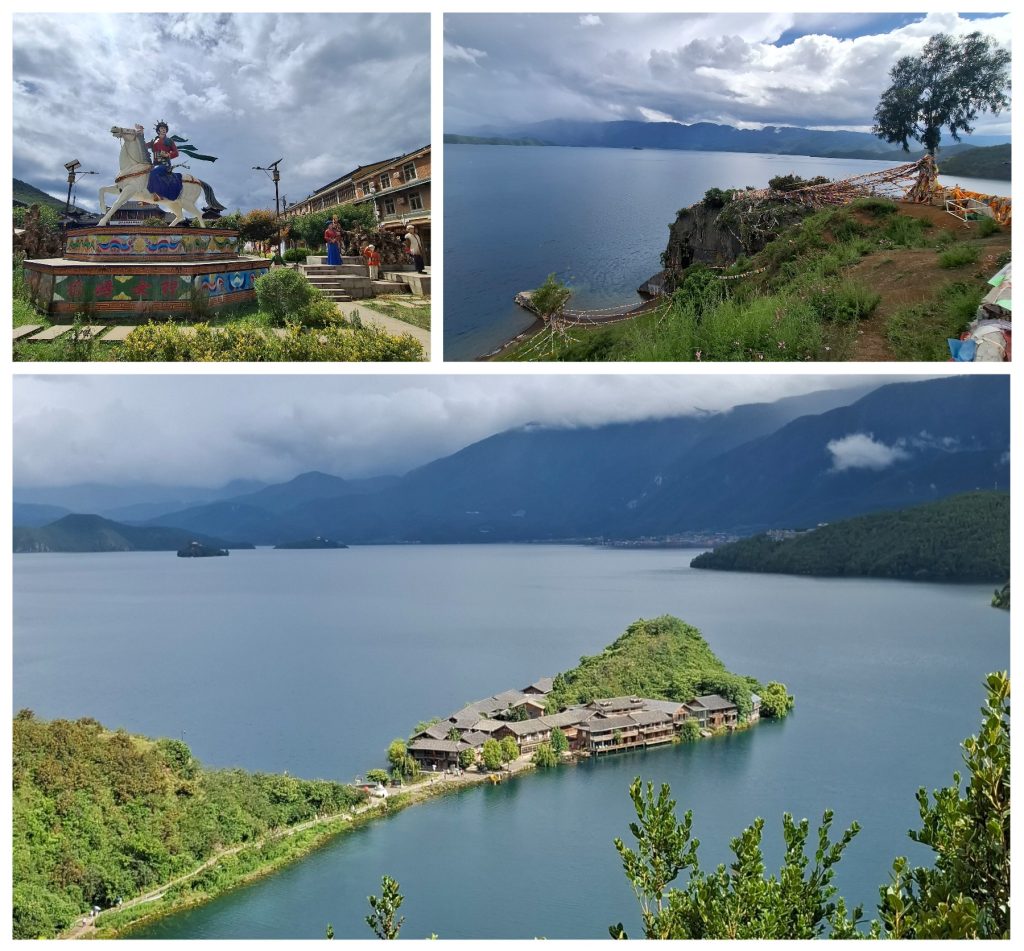
We buy some bananas at a local market, admire the statue in the market square and make one more stop at the Luyuan Cliff observation platform.
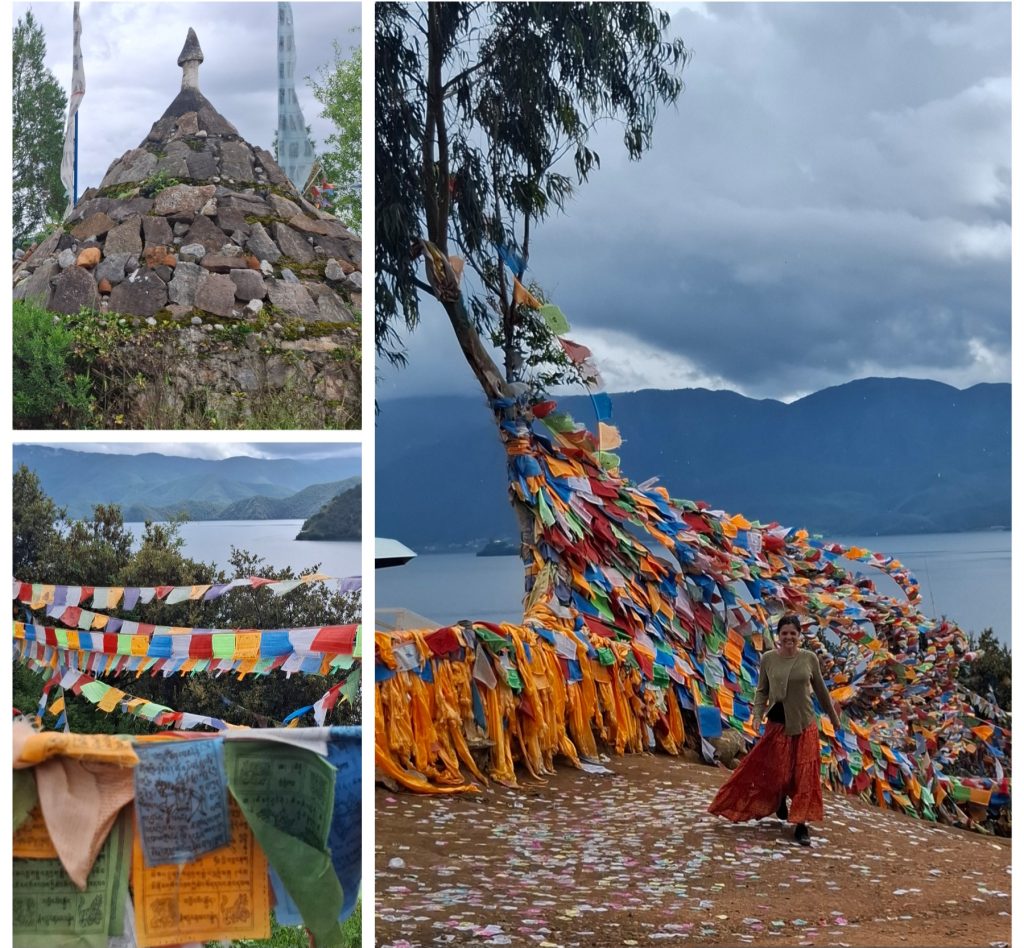
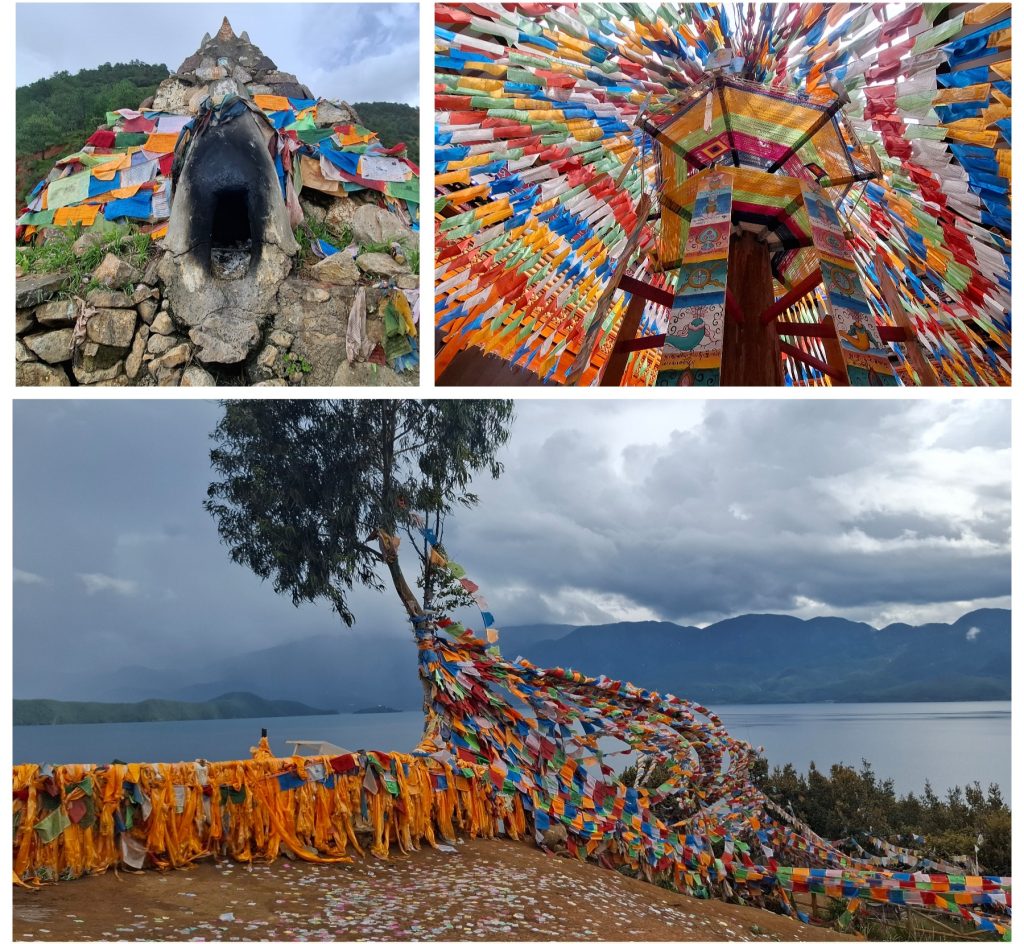
The view is amazing, and the colourful prayer flags make this place feel especially magical. We are lucky with the weather once again! It is already raining on the other side of the lake.
There is more traffic now as we are getting closer to Daluoshui, a more developed and touristy area. We make one last quick stop at Lover’s Beach, packed with Chinese visitors taking the usual photos.
Satisfied and tired, we arrive back at our hotel around 5 p.m. “Our” Gemu Goddess Mountain, seems to welcome us home.
I am so grateful that I chose this peaceful spot!